Manenberg Contact Centre

Client: City of Cape Town
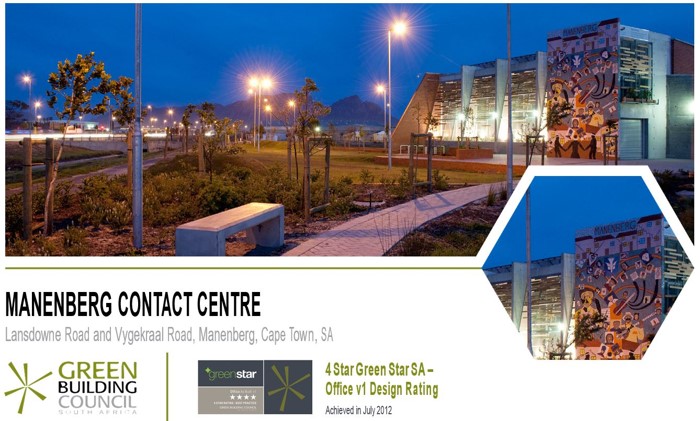
As the City tackles the ongoing water shortage challenges, questions arise around what systemic changes will be made to engender a new relationship in the future with this precious resource. Because much of today’s water governance was prepared in the 1980’s and ‘90’s it does not meet the challenges created by current urbanisation and climate change. A forward-thinking City of Cape Town official, Ashley Hemraj realised the magnitude of the challenges and in 2012 commissioned the Manenberg Contact Centre. The building has bucked the “norms” and set new trends and was awarded four stars by the Green Building Council for its high environmental and implementation standards.
At the time the Manenberg Contact Centre was completed South Africa was experiencing an energy supply crisis. Consequently, the design’s energy innovation was showcased with less emphasis on water innovation, but this aspect of the design has become more relevant recently as Cape Town experiences its third drought year.

The Manenberg Contact Centre has an integrated water system that is underpinned by two principles. It aims to reduce the demand on municipal water supply by using water-efficient devices such as sensor taps for wash handbasins and it optimises the municipal water used by re-using and recycling wastewater (greywater, blackwater and conditioner condensate) and augments with alternative water (non-municipal water such as rainwater or groundwater and surface water) for non-potable purposes, including irrigation and toilet/urinal flushing. Because the quality of alternative water may be different to municipal water, it is reticulated through three separate plumbing systems. The resultant integrated water system re-uses all of the municipal water supplied to the building and generates zero waste.

Further reductions have been achieved by lowering the landscape irrigation requirements that typically account for most of a development’s municipal water demand. The Manenberg Contact Centre’s landscaping requires little water which makes it possible to supply water using onsite alternative water. This was enabled by selecting xeriscape plants that have low water needs and using an efficient irrigation system. Xeriscape plants are abundant in Cape fynbos species which makes many of them ideal for water-scarce areas, including Manenberg. The low-level, drip irrigation system optimises the water by keeping it close to the roots where it is most needed and limits air exposure by dripping directly onto the surface thereby preventing wastage via evaporation. Municipal potable water initially augmented the irrigation water supply whilst the planting was being established, but since the landscape has been established, all irrigation has been supplied by alternative water.


The capital investment for the alternative water system was approximately R650 000 and included pumps, tanks, a treatment system, leak detection and a dual plumbing system. The payback period was initially estimated at 10 to 15 years. These calculations were conducted in 2012 and were based upon a much cheaper water price, which is no longer the case. It is believed that the capital investment for alternative water and energy has already been largely offset by the long-term performance of both, and that it accounts for a 50% reduction in the overall annual operation and maintenance costs.
Whereas the benefits of alternative water and water saving devices are obvious, there are other, less apparent benefits supplied by for example the landscape.
Manenberg is a dense urban area that needs additional high quality open space. The Manenberg Contact Centre meets this need by offering the community open space and a children’s play area. The plants in these areas create a pleasant space to be and also attract birds, butterflies and other insects and animals that create faunal and floral biodiversity and supply “green” connectivity to the Lotus River Canal and Edith Stephens wetland area located adjacent. Whilst the landscape supplies biodiversity, it also supplies important eco-services by improving air quality and assisting the larger City community by providing shade that cools temperatures and absorbs atmospheric carbon dioxide that would otherwise trap heat causing global warming and climate change. The landforms add interest in the landscape and are also functional bio-retention ponds. They are part of a sustainable urban drainage system that manages stormwater onsite, creates opportunities for groundwater re-charge and improves water quality by phytoremediation which is a process that uses plants to remove water pollutants.
The water-sensitive Manenberg Contact Centre has set the trend for the City of Cape Town and deserves its accolades. By illustrating best practice and offering lessons for future projects across sectors it goes a long way towards informing systemic changes including new norms and standards that will undoubtedly contribute towards securing Cape Town’s water future.
Subscibe to the low volume newsletter and get updated when there are new articles