‘Walk this way to the time of your life’, the Cape Town Fan Walk
By Tamsin Faragher – First published in TOPOS (2012)

A city is not a city without its life-blood, people. In the ‘bad old days’ of South African history, some people were given rights and others were denied rights. Some rights allowed some people into the City and others not. It was complicated. Fortunately, things have changed and most people have most rights for most things. And this could not have been illustrated any better, than during the 2010 FIFA World Cup.
The truth, is that large, international events, such as the FIFA World Cup, are often viewed as a wet, dirty puppy, suspiciously, held at an arm’s length lest they soil a dapper outfit. A natural reaction considering the unpredictable post-event experiences of previous host cities. How does one plan for a successful tournament inclusive of a lasting legacy? How does one plan to ‘get it right’? And then ‘get it right’? Some might say its all about good design and others might say it comes down to luck. It seems safe to assume that its most likely a combination of both.
The Mother City, as Cape Town is fondly referred to, is a small city hidden under the majestic Table Mountain. Its strategic location on the historic Dutch and Portuguese trade routes to the East made it a sensible place to establish a fresh produce market from which passing ships could replenish supplies and source water from the numerous mountain springs.
The City’s public open space system is a remnant of this time of market squares and vegetable gardens. Even the street grid structure is a living memory of the water sloots that tendril-grew outwards from the Company’s garden located in the heart of the City. This dense, structured pattern changed as the City exuberantly splashed its way out of the bowl and spilled well beyond the city limits and out onto the Cape flats, suspended tautly between the two mountain ranges.
The old, creaking infrastructure that supports this ungainly urban morphology, was no match for the modern, high-tech event envisaged by the organisers. To remedy the situation, various projects were implemented, amongst others, a new stadium. To this end, numerous sites were analysed, with a variety of outcomes, but ultimately, the old Green Point stadium site controversially prevailed. The redundant structure was demolished and a new facility constructed, including a metropolitan urban park.
It is believed by many that public spending should be aimed at stimulating the economy and that it therefore be located where it most benefits the public, ergo, in the poor townships. The Green Point area has sleek, tree-lined streets that zoom to the City in ten minute trips while the sea laps against the bustling promenade a short walk away. This area bears no resemblance to the remote, dusty, higgledy piggledy townships with its great thirst for economic stimulation.
These spending reservations, were compounded with planning concerns, as of the three sites, the Greenpoint Stadium site offered some of the greatest constraints. This is most notably, transport as the site is located 2.4kms from the Station, the only source of public transport. Enabling the movement of the anticipated volumes of people entering the City and connecting them to the Stadium from the main transport hub of the Station, became the crux of the Integrated Rapid Transport System (IRT) which included the myCity bus routes and the refurbishment of the Station.
The IRT planned for match days where 68 000 ticket holders would head towards the Stadium,18000 of which would be pedestrians. The transport planners predicted disaster – South Africans don’t walk and certainly not more than 750m. Walking is something we do whilst on holiday in European cities, not in South African cities.
This attitude was by necessity, all about to change, as it was simply not possible to physically transport the full volume of ticket holders by bus. People would have to walk. But where? It made practical sense to create a direct pedestrian route to connect the Station to the Stadium. The route that fulfilled these requirements by happy coincidence, ran along the historic and exuberant, Cape Minstrel’s New Year’s festival route. It may have been the most direct, but it also offered challenges as it lacked definition and crossed almost impassable roads.
The route starts at the Exchange Square opposite the Station across from the pedestrianised St Georges Mall. From here it connects onto Waterkant Street, crosses the new bridge that spans Buitengragt Street and into St Andrews Park. A pedestrian pathway connects in turn to Somerset Street, before the route dips under the new Greenpoint Traffic Circle and terminates at the Stadium.
The red brick pathways, street furniture and signage establish the route’s character and connect to the existing fabric, whilst acting as a catalyst for urban renewal. It was found that the adjacent property owners, in response to this intervention and upon their own initiative, upgraded their buildings. They created engaging interfaces, validating beyond expectation the initial capital outlay for the landscape works.
The City’s current pedestrian network’s limited scope is comprised of a few pedestrian priority areas connected by the almost thirty-year-old St Georges Mall. This is a bustling, contained pedestrian realm linking public places, including the popular Greenmarket Square. The success of this development is borne out by property market surveys that suggest it commands the highest rentals in the City centre. Even after this evident success, it is only now, with the Fan Walk, that this embryonic pedestrian network extended for almost the first time since the completion of the St George’s Mall.
Perhaps it was the variety of street spaces characterised by human-scaled, often historic buildings, pedestrian priority areas, street cafés and shops that shifted perceptions? Or the musicians, streets artists and artworks that gathered in the bends where the pedestrian flow slows and eddies into for example, the lawn terraces of The Ossiary adjacent to St Andrews Square? Or perhaps, it was the No ticket? No problem! attitude that ensured that everyone felt welcome?
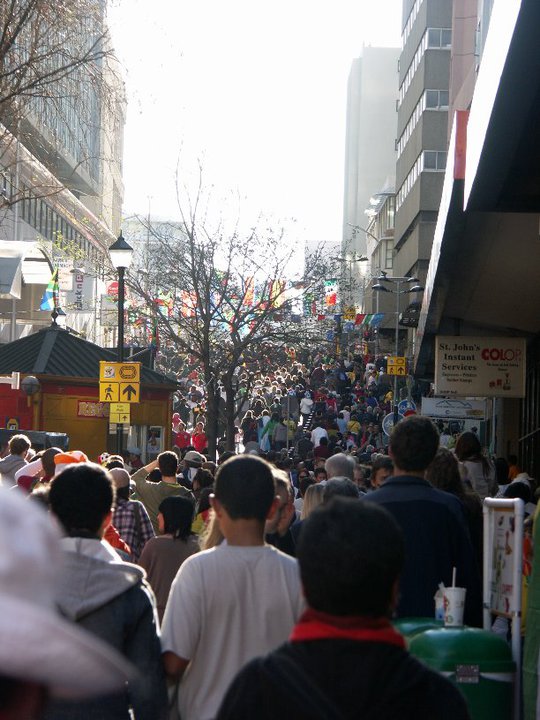
Whatever it was, it had become a destination in its own right as was shown on match days when streams of visitors and Capetonians salmon-battled their way to and up the Fan Walk, a magnificent, rainbow-coloured torrent.
According to the Cape Town Partnership post-event report, ‘on the 3 July, with a Stadium crowd of 64 000 already in their seats, there were still an estimated 92 000 fans on the Fan Walk’. These people travelled into the City for a day out of flag-waving and soaking up the free atmosphere. This was a completely new experience for many locals, some of whom had never travelled into the City using public transport, let alone at night. The bus capacity lagged at a 50% total usage during the tournament with the Stadium-attached designated parking areas, echo-ingly empty. Everyone was on the Fan Walk.
So what did Cape Town do that was so special? According to the transport planners, they did nothing. The Fan Walk was really a happy accident that resulted from the synergies created by the Stadium and transport hub locations and the co-incidental need for human movement, by bus and foot.
Perhaps, but the first phase of the myCity bus network was designed and implemented for the World Cup and it is still slowly and deliberately boring its routes throughout the City. It is no accident that this network provides a level of public transport never previously imagined possible in an African city. Had the bus capacity met the needs of the Stadium, the Fan Walk may never have been constructed. Had South Africa not been awarded the 2010 FIFA World Cup, Cape Town’s myCity bus network may never have been implemented. Rich food for thought.
The success of this intervention is providing precedent for current studies that investigate the potential of pedestrianising Long Street. The established management norms initiated during the World Cup, have ensured that the Fan Walk’s popularity is maintained and that subsequent events are of an equal standard, be it a local league football game, or an international concert. The Fan Walk as a public space, acknowledges our immense human diversity and the astounding reality that people are really just social animals who thrive in safe and engaging environments.
Whatever the case may be, the Fan Walk planning and design team have reason to climb out from ‘under the table’ and take credit for radicalising Capetonians’ perceptions of public space and influencing the future development of the City.
The last time the City had been as jubilantly gorged was twenty years prior, when Nelson Mandela addressed the world from a City Hall balcony over-looking the Grand Parade to a crowd that spread as far as the eye could see.
For the first time since then, whilst during the small bubble of the FIFA World Cup, the City once again belonged to everyone, vuvuzelas and all. For those lucky enough to experience the Fan Walk, it really was a case of ‘Walk this way to the time of your life’.
Subscibe to the low volume newsletter and get updated when there are new articles