Can South Africa’s proud heritage of womens’ activism and landscape architects meet the urgent demands of climate mitigation and adaption?
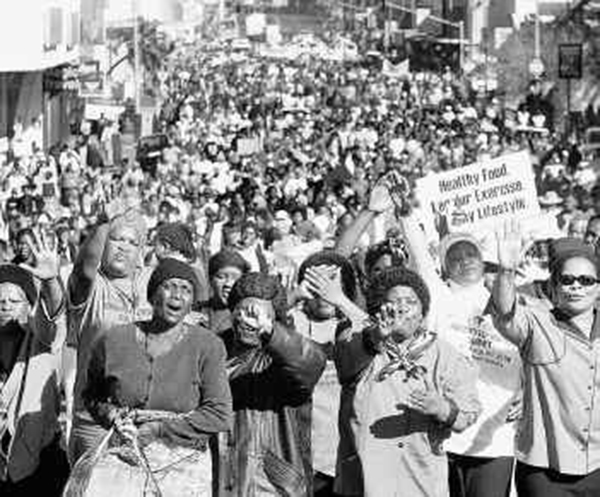
Women have played a significant role in the struggle for South Africa’s freedom. Today’s dangers and battles are those against unseen threats that manifest in the extreme weather resulting from climate change and the underpinning structural economic inequality. This blogpost reflects on a recent Institute of Landscape Architecture of South Africa webinar that focused on the impacts of climate change on women.
The UN Framework Convention on Climate Change (UNFCC) describes climate change as a planetary phenomenon that will impact all countries, but with effects further shaped by pervasive and entrenched gender inequality. Because women are more likely to live in poverty than men, they are disproportionately affected by heat waves, droughts, rising sea levels, and extreme storms. They also have less access to basic human rights and experience systematic violence that escalates during periods of instability. The Paris Climate Agreement (2016) acknowledges women’s vulnerability and includes specific provisions to ensure women receive support to cope with the hazards of climate change. It is four years since South Africa ratified this agreement, but it would a challenge to identify any related actions over the interceding four years.
Landscape architects, who are the architects for nature, understand how the wellbeing of humankind is tied to the well-being of the natural environment. Consequently, they play a central role in responding to climate change to ensure that humanity is better able to meet the existing and coming challenges that include not only climate change, but the associated gender-based violence too.
South Africa’s proud legacy of women activism must now more than ever be ignited and galvanized towards challenging the status quo and making a climate positive impact that improves the lives of girls, women and the broader communities they live in. This is especially important for Cape Town, a city located in a country that is the 13th highest global greenhouse gas emitter. But is this a reasonable expectation of society’s most vulnerable?
Work towards shifting the status quo commenced in Cape Town with a “Cape Town Climate Change, Hazard and Vulnerability Risk Assessment: 2021-2050” conducted by OneWorld (https://oneworldgroup.co.za/oneworld-projects/climate-change-assessment-capetown/) (the Study). The significant hazards included drought, fire, heatwaves, floods and strong winds with their cumulative impacts and threat of increasing frequency and intensity.
The study looked at current and future hotspots and the predicted increase in risk. An economic lens was applied using six “capitals” including financial, human, natural, social, manufactured and intellectual. The interplay between the capitals and their resilience in the face of climate risks was tested. Of all the areas within the city, Guglethu, Bishop Lavis, Elsies River and Manenberg were found to have low capital and high risk with Philippi and the Airport also falling into this risk category, presenting economic and food security vulnerability, which ironic considering that Philippi is often described as the city’s breadbasket”.
OneWorld’s Belynda Pertie argues that communities should be considered as partners, rather than beneficiaries in the COVID-19 recovery “building back better” thinking and that discussions must be inclusive and focus on vulnerable, high risk, lower economic communities that have high elderly and/or female populations.
It is imagined that this sensible argument would be applicable to the investment pathways recommended for mitigation and adaption. The UN Environmental Programme defines mitigation as efforts to reduce or prevent the emission of greenhouse gases. Interventions could include new technologies and renewable energies, making older equipment more energy-efficient or reducing the need for energy consumption by implementing sustainable urbanisation comprised of high quality, dense communities located within proximity to work, amenity, culture and transport facilities.
Public transport, bicycle paths, renewable energy supply and energy efficiencies typically accrued through building development are key development structuring elements as is the impact of development on infrastructure. Increased density however results in higher demand and a reduction in supply for services such as water, whilst also exerting pressure on natural resources. Ms. Petrie suggests that South Africa’s poor track record of water infrastructure needs improvements through design thinking and better resource management.
On the other hand, adaption is defined by the Inter-governmental Panel on Climate Change as “any adjustment in natural or human systems in response to actual or expected climatic stimuli or their effects which moderates harm or exploits beneficial opportunities”. Climate adaption projects could therefore include the incorporation of high-value ecosystems into urban areas that are sustainably managed and that provide equitable green spaces and reduce risk by disincentivising settlement in hazardous areas such as floodplains.
Ms. Petrie believes that it’s too late to stop climate change and that there will be lasting consequences no matter what we do now, so now it is a question of the extent to which we can reduce and mitigate climate change. She challenges landscape architects to consider their role in creating sustainable city densification; integrating climate conscious design with adaptive economic activities; and promoting sensitive resource use (e.g. water or land) towards greater productivity.
Even though women have the most to gain from positive climate action, it seems unlikely that there will be an upwelling of womens’ activism in response to climate change, especially as their resilience is already greatly impacted through COVID-19.
Landscape architects on the other hand can undoubtedly have a positive impact and by placing community safety and women and child vulnerability at the centre of their design thinking, they can effect positive change. The intersections between climate change mitigation and adaption and landscape architecture are illustrated in the roles previously described. They indicate an unambiguous role for landscape architects in the realisation of a climate change response that responds to the needs of vulnerable communities, including women and children.
Project team structures, the default to hard-engineered solutions and the limitation of landscape architecture work to the cosmetic however diminishes the role that they play and this must change if South African cities are to meet the urgent need to respond to climate change.
Subscibe to the low volume newsletter and get updated when there are new articles