Founders Garden – a missed opportunity for water sensitive development? Or overflowing with potential?
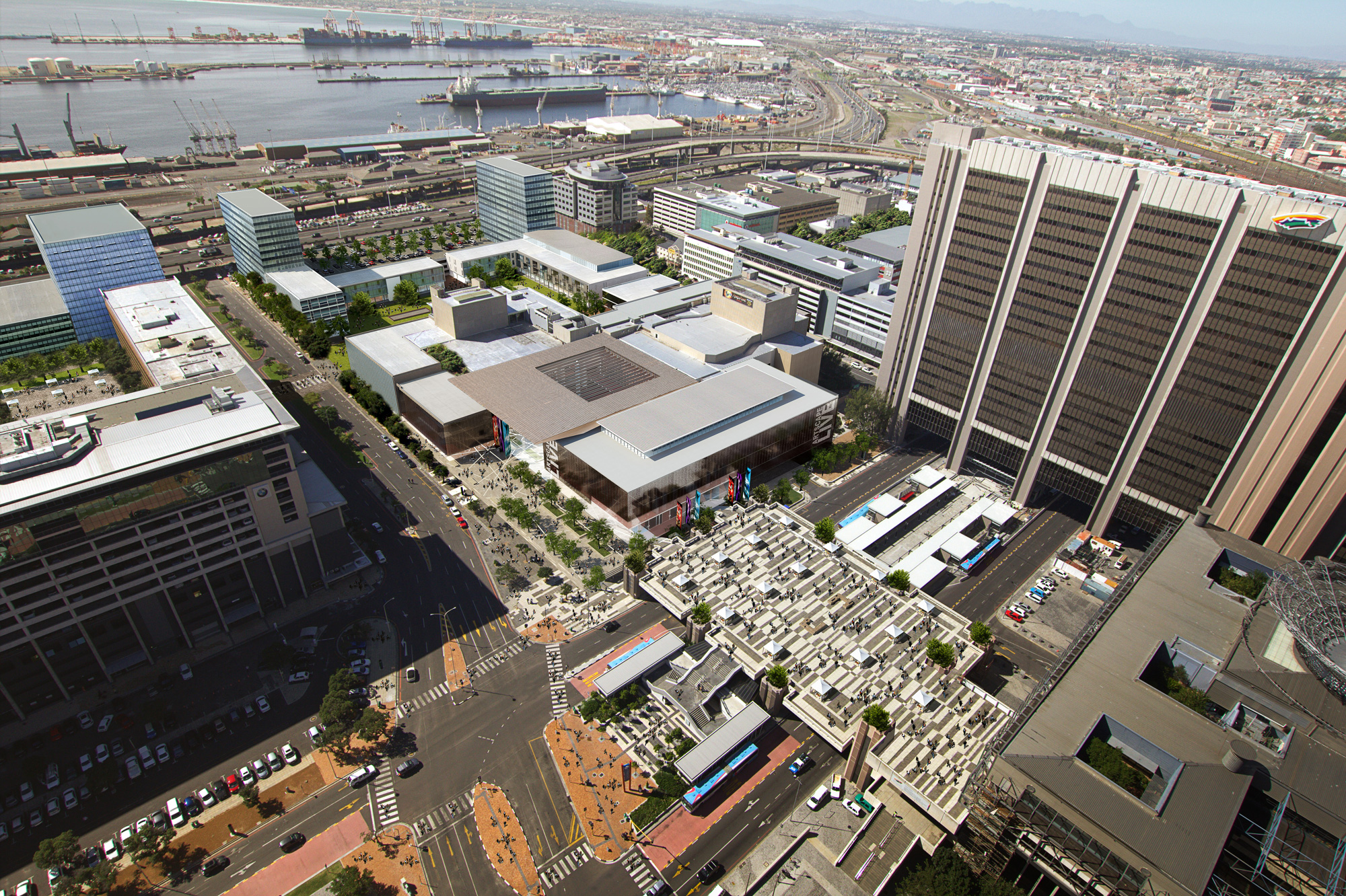
Founders Garden, a Western Cape Government Department of Transport and Public Works flagship project has been in the works since 2010 when the Cape Town Central City Regeneration Programme was approved by the incoming DA Provincial Cabinet. Renewed interest in the project due to the invitation to submit comments on the current scheme prepared by DesignSpaceAfrica, has reminded me of my work as a technical advisor to the DTPW Regeneration team responsible for packaging the projects for market and made me wonder at how much things have changed. And how little.
Built on the premise that government property are assets and therefore have a value that should be optimised. The grand plan was to:
- Unlock Cape Town’s potential to become a city that serves the needs of all its citizens as one of the world’s great cities of the world;
- Leverage private sector investment, capacity and expertise;
- Refurbish and achieve savings in the operation and maintenance of its properties; and
- Generate an income stream to finance provincial property development and maintenance.
Described by some as the “jewels” in the Western Cape Government’s property portfolio, the six Central City properties, including, Founders Garden (also referred to as the Artscape Precinct) became the fulcrum to this plan. I was privileged to work with some remarkable individuals in putting the “meat” on these plans which culminated in a development framework prepared by CityThinkSpace, the design consultants who worked in partnership with GIBB Africa engineers.
The two properties located on the city’s Foreshore, combine to form a site abutting the elevated freeway, the Artscape, CTICC and the Civic Centre. Initial design considerations included the now complete Netcare Hospital, which was in planning at the time. The site was seen as a way to connect the neighbours, offering a large area of structured parking for the hospital, CTICC and the Artscape. The hospital has since been completed in the absence of the parking committed at the time, a commitment that was never formalised. The 2012 CityThinkSpace development concept “envisages a mixed-use development that will activate the Foreshore area and be a catalyst for regeneration” with the current development concept describes a “integrated high-rise, residentially-led, mixed-use development in the form of a rental scheme, which aims to maximise the provision of social and affordable rental housing, while also providing open market rental units”.
At the time of the initial conceptualisation building up to 2012 was for developments that were commercially viable. Social housing leverages off the assumption that the land is provided for free, a commercially unviable option for a mandate that seeks to generate an income. The Conradie Hospital, which was incubated in the Regeneration Programme, has successfully structured the finances for a development that brings commercial and social/affordable housing together in a financially sensible way, possibly informing the prescripts for the Founders Garden development. It would be interesting to know how the Founders Garden land value is represented in the financial modelling and if it has been included “mahala”. The Regeneration Programme mandate to generate an income from the City Central properties was the major stumbling block to its wider inclusion of social/affordable housing, especially for the City of Cape Town that strongly promoted the need for government to commit well-located property for this purpose, although interestingly, at the time, showing little commitment to do the same. It can only be assumed that pressure from civil society groups over the interleading ten years and last year’s court judgements relating to the Tafelberg School project have helped to effect this shift towards enabling different thinking, such as what is evident in the current Founders Garden concept.
What hasn’t changed in the last decade is the thinking around the the built concept that includes high rise buildings and a greatly reduced “garden” space. Because Founders Garden sits at the nexus between the Netcare Hospital, Artscape and the CTICC, its planning featured in both development plans, with large portions of parking shifted off their sites to the Founders Garden site. In some ways, the delays to the launch of Founders Garden has allowed for a re-calibration and less of an emphasis on parking on the site, that better reflects the city’s journey towards a carbon zero future.

The divergent ideas explored by the various design teams is evident in how “garden” is conceptualised. The 2010 concept shows discreet development on the edges of the site, which is very different to the current proposal that has greatly reduced the “garden” space and also increased the bulk that is allocated to the sides of the site to frame the view from the freeway to Table Mountain.

Precinct Plan from Central City Regeneration Programme, DTPW, 2010 showing discreet development primarily on the Elevated Freeway edge 
Precinct plan prepared by DesignSpaceAfrica, 2020 showing development on three sides


Images above from DesignSpaceAfrica’s website illustrating the broad massing.
The GAPP Architects proposal for the Artscape Precinct (2012) illustrates a lower bulk articulated to enclose an arts-activated public space, see image below.

The increase in bulk is most likely tied to the financial model, necessitated to cross-subsidise the social/affordable housing.
Issues around public space – or rather – good quality public space – is ongoing in all cities intent on creating liveable cities. Over the last few years, the Foreshore has seen the approval of a number of high bulk developments, mostly mixed-use, that will provide homes to thousands of Capetonians. Nurturing public spaces to support these developments is necessary not only for recreation, but for cooling and ensuring a balance between the urban and natural systems.
The Towers development by Redefine Properties, located a short walk from the Artscape site illustrates how massing can create a pocket of calm, but also a wind-protected, urban oasis that is enormously popular for those working on the Foreshore, see photos below. The building integrates and responds to the open space and forms an important connection that allows for rainwater harvesting.


Whilst there is justifiable focus on social/affordable housing and bringing people into the CBD to undo the wrongs of Apartheid planning, it must not be at the expense of sustainability and resilience. Through the drought experienced across the Western Cape and acutely in the City of Cape Town, the largest urban area to be affected, we all learnt about the value of water and the need to innovate.
Water was never a specific part of the Regeneration Programme, beyond references to “sustainability”, but in reality, we didn’t always have all the ‘hooks’ we needed to push this agenda towards meaningful outcomes, beyond the Two Rivers Urban Park work that embodied all aspects of sustainability, though much reduced in its current iteration that leaves it largely meaningless. But – in today’s world where we do know better, to ignore the potential of every development to become part of a “sponge” city is downright negligible.
Developments such as The Towers illustrated the many ways that rainwater can be treated and stored on site that add to a beautiful public realm, over and above the basement water that it reticulates to flush toilets, rather than discharging into the City’s stormwater system for disposal to the sea. Basement water is a hazard for many of the Foreshore buildings and without pumping, would render parking areas unusable. The challenge for many of these buildings is that their built form and structural design never planned for onsite water storage and retro-fitting for this purpose is a challenge. For new buildings however – there is no excuse for not actively looking at opportunities to store and treat both rain- and basement water on site. Public open spaces offer ideal locations for storage and bioremediation (using nature to treat water) and they must therefore be treated as critical green infrastructure that is as important as electricity and sewage services. It also provides rich design opportunities that establish unique place-making, as seen in Perth Cultural Centre Wetland, see link below and the youtube video is well worth watching.
In the event that basement water is not an issue on Founders Garden, there may be an opportunity to receive, store and treat another building’s basement water, for example the Civic Centre, which pumps groundwater from its basement on a daily basis. This water, combined with stormwater reticulation within the precinct and rainwater from the buildings in the precinct could be reticulated into the buildings for toilet flushing, which is the largest water part of a home’s water usage and for irrigating the open space.
Whilst the legislation may (incorrectly) define basement water as waste, it is a very valuable resource for non-potable uses and should be treated as a scarce and precious resource, along with stormwater. All effort should therefore be taken by all spheres of government and developers to better understand where these resources are and to identify the opportunities to implement the principles of a water sensitive city, which includes concepts such as the sponge city that refers to the creation of pockets of water storage throughout a city and is one of the building blocks a water sensitive city.
The CRC for Water Sensitive Cities, currently working with the City of Cape Town and the Western Cape Government on a water sensitive city benchmarking exercise recently published an article titled INDIA—tailoring site-specific water sensitive solutions, see image below and link. https://watersensitivecities.org.au/content/india-tailoring-site-specific-water-sensitive-solutions/

Water sensitive development concepts are no longer those belonging to a fringe element of the Tin-Hat Brigade or academic theorists, they are fast becoming mainstream. There is no reason why the ideas illustrated in the image below, could not be included in the Founders Garden development. But for this to happen, they need to be planned in from inception to ensure that they are integrated into the precinct framework, open space and building designs.
At the time that the Cape Town Central City Regeneration Programme was prepared in 2010, a few City of Cape Town officials were working to respond to water scarcity warnings. Their action resulted in the Manenberg Contact Centre that is largely off the water grid by storing and treating rainwater and sewage onsite. In 2010, the Regeneration Team could not have known for certain that the “millenial drought” was five years away. But in 2021, we know. Or at least, we should know, because we lived through it. Either way there is no excuse for not looking at how we value water and integrate it into all the development work we, as built environment professionals do, across the scales from precincts to buildings.
In retrospect, whereas in some cases, not much has changed since I stopped consulting to the Department of Transport and Public Works in 2014. In others, quite a lot has. The shift to include social/affordable housing on the Founders Garden precinct is awesome and worthy of excitement, even if the greatly reduced “garden” is questionable, especially in a part of the city that is densifying at pace and within the context of climate change and associated heat shocks.
The Department of Transport and Public Works has led the way in reducing their buildings’ water demand, but also in optimising alternative water sources and sustainable drainage systems (SUDS) – all building blocks of water sensitive development. The Mitchell’s Plain hospital is a SUDS shining beacon. But this leadership must be amplified through the development opportunities they offer the private sector who apart from mavericks such as Redefine and Growthpoint, have been slow on the water sensitive development uptake. There is no doubt that their influence and water sensitive development leadership contribute towards smoothing Cape Town’s water sensitive city pathway.
Founders Garden is water sensitive development opportunity ready for planting, but it will need water and nurturing to thrive.
If you have views on the Founders Garden Precinct Development plan – email them to monique.africa2@westerncape.gov.za on or before 16h00, 22 January 2021.
https://citythinkspace.com/founders-garden-precinct/
Subscibe to the low volume newsletter and get updated when there are new articles