Groundwater Governance and Management – A framework for Local Government
The following excerpts are from a recently completed research report. The full report is available at the end of the post.
Background
An invitation was made to City of Cape Town officials to participate in the Urban Mistra Futures Programme hosted by the University of Cape Town, African Centre for Cities (ACC) in 2019. The purpose of the programme is to generate reports and journal articles that capture government officials’ experiences for knowledge creation and to strengthen capacity within these government departments.
Groundwater has been identified in the Resilience Strategy (City of Cape Town, 2019) under a number of actions. It specifically identifies the need for responsible borehole use in Goal 4.3.1: Launch a borehole data capture and owner awareness project. The goal aims to achieve responsible borehole and well-point use by private owners for the purpose of protecting and sustaining groundwater by using innovate data and awareness campaigns, and collective action during times of shock to leverage individual resources for the public good.
Tamsin Faragher actively supported the Water and Sanitation Department and the Enterprise and Investment Department during the drought. This work included business engagements related to alternative water use, including groundwater. Many water governance issues pertaining to groundwater emerged through this work and work towards the author’s MPhil underway at this time titled Sustainable Water Governance; An Incremental approach towards a decentralised, hybrid water system (2018). Tamsin joined the Resilience Department in August 2019 at which time the Mistra cohort was announced. The convergence of these events presented an opportunity for the author to explore water governance as it relates to sustainable groundwater management in the City.
| Water is described as colourless, tasteless and odourless – its most important property being its ability to dissolve other substances. We in South Africa do not see water that way. For us water is a basic human right, water is the origin of all things – the giver of life. |
During the course of the research project, it emerged that the WWF had current and ongoing work related to the establishment of water source partnerships. The research for this report has served to inform this work.
Groundwater is progressively viewed by water service providers – including the City of Cape Town (the City) – as an important part of diversifying water supply sources. Before the Western Cape drought (2015-2018), groundwater use in Cape Town was mostly by households and agriculture. During the drought, there was a significant increase in household groundwater uptake and it is now also part of the City’s water supply augmentation plans. Going forward, the City and households will be making separate use of the same water resource. While water governance establishes municipalities as water providers and enables rural households beyond the reach of service providers to access water to meet their needs, it does not consider the agglomerated impact of high numbers urban groundwater users and the impact of these users (self-supplying potable and or non-potable water) on groundwater reserves and municipal finance.
National government, though mandated to manage all water resource (abstraction and management for recharge) irrespective of the geographic location, limits its management to licenced groundwater users in both rural and urban areas. While the City’s groundwater use is regulated with a license, smaller household water users are unregulated and unmonitored.
While governance as it applies to water supply is an issue, the principles for water management treat it as a discrete ‘resource’ for supply using engineered infrastructure and not holistically as an integral part of a complex series of ecological relationships. Water management complexity increases in urban areas where interactions between urban development, the natural and urban water systems add further challenges. The governance and management for these elements does not consider the complexity of these interactions or the resultant negative impacts on natural water resources.
Ongoing speculation around the responsibility for managing household groundwater users and aquifers located in urban areas persists with the impact of unregulated abstraction unknown. Urgent governance and management reform is therefore needed to prepare the City, and other South African cities – for hybrid water supply systems for a water-scarce future.
Introduction
This research is based on the premise that groundwater is part of a broader, integrated system comprised of urban and natural water cycles that function within both natural and urban environments. The two systems operate in a particular way in response to governance comprised of policy, strategy and plans implemented by technicians employed by institutions. In other words, governance is the tool that shapes the design, operation and management of the water systems – including groundwater – and technicians use the tool to deliver outcomes, as per the governance. It follows that the water system is a physical and operational manifestation of the governance. The report investigates the current governance to determine if it will build a water-resilient future.
Chapter 1 provides an introduction to groundwater in Cape Town and its role in meeting the challenges of climate change, adaption and resilience within the context of municipal and household supply. The chapter concludes with the identification of opportunities, gaps and constraints followed by the relevance to local government.

Cape Town’s unprecedented 2015/2018 drought reinforced the progressively increasing water scarcity across South Africa. Even though Cape Town managed supply down to 50% through water demand management, “demand management alone will be an insufficient adaptation measure for future climate scenarios (Atkins, Flugel, & Hugman, 2021). In 2013, estimates suggested that domestic water use over the preceding ten years had increased by 5% from 22% to 27%. Forecasts for the ten years following (to 2023), presumed sufficient supply and anticipated a 1.2% growth (Department of Water Affairs, 2013). In contradiction, warnings as early as 2000 indicated that water demand exceeded availability in eleven of the nineteen water management areas, despite a small national surplus. At this time, it was estimated that there would be a water supply shortfall by 2025 (Department of Water Affairs, 2001). A WWF 2017 study draws on the Strategic Water Partners Network South Africa: Closing the water gap by 2030 (2009) that quantified the extent of the shortfall, suggesting that by 2030, demand will exceed supply by 17% (WWF, 2017). These predictions point to rapidly increasing water scarcity across South Africa and the South African Development Community (SADC) region more broadly. By necessity, all levels of government and individuals are concerned with water management and supply augmentation.
Unlike Cape Town, where augmentation planning estimates that groundwater will supply 7%[1] (City of Cape Town, 2019) of overall supply by 2040, 70% of people living in the SADC region are already dependent upon groundwater (SADC-GMI, 2019). With 60% of local governments in South Africa already making use of groundwater as a water resource (Fourie, 2020), the notion that it is a water resource “seldom considered in urban water management” is incorrect (Foster, et al., 2010). Mvandaba et al. (2019) support this observation and estimate that only 11% of the total population reside in settlements dependent upon groundwater for water supply. These are mostly rural village clusters or small towns, with all 11 metropolitan municipalities mostly reliant on surface water supply (>50%) (Mvandaba, et al., 2019).

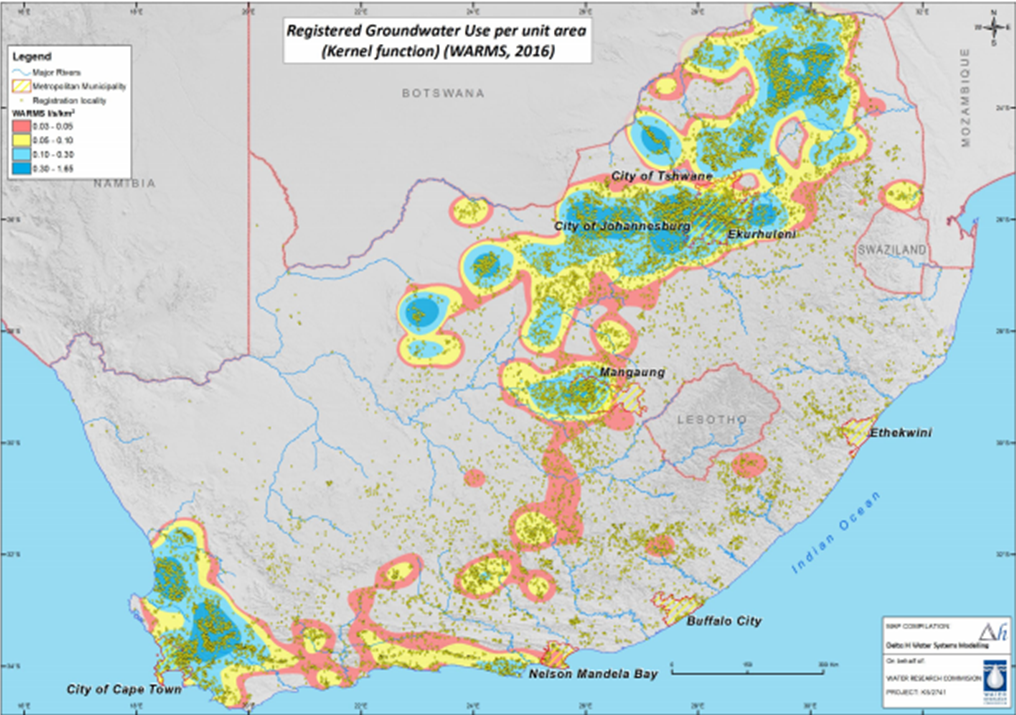
Registered groundwater use in the Water Authorisation Registration Management System (WARMS) database amounts to 2,466 Mm3 (million cubic metres). Predictions are that this will increase by 39% in small towns and rural areas over the next 7 years, but that even so, this quantity is well below the 19,000 Mm³ of groundwater that could be abstracted on an annual basis (CSIR, 2021).
The risk of water scarcity in the Western Cape and City was raised in:
2007: Western Cape Water Supply System – Reconciliation Strategy Study (Department of Water Affairs and Forestry, 2007); again in
2010: Integrated Water Resources Planning for South Africa – A Situational Analysis (Department of Water Affairs, 2010); and in
2013: National Water Resource Strategy (2) (Department of Water Affairs , 2013), were not acted upon.
The unprecedented low rainfall between 2016 and 2018 across all three supply catchments resulted in a 1:590-year drought that heavily impacted the surface water-supplied system, forcing the urgent consideration of the adoption of alternative water sources (City of Cape Town, 2018) as a means to build resilience into the water management system. During the drought there was a noticeable increase in borehole-drilling primarily for private use, suggesting local recognition of the limitations of surface water availability and groundwater’s potential role, especially in urban areas. By comparison, the uptake of groundwater by business and manufacturing was limited during this period due to the long lead-times for water use licenses. While the City of Cape Town (the City) managed the distribution of water supply using water demand management, augmentation using expensive (emergency, small-scale) desalination was also initially pursued. A World Bank review critiqued this approach and recommended the prioritisation of large-scale groundwater development, particularly in the shallow Cape Flats aquifer which would provide a rapid response to the crisis and establish the pillars for long-term water resilience (Marino, 2017).
Small-scale, household groundwater use from the same aquifer is currently un-measured and unmanaged (World Bank, 2021). Consequently, data is not available to determine the aggregated impact that these users have on aquifers. The focus on large water users therefore presents a challenge to establishing and managing an integrated, complex hybrid system comprised of large and smaller water users because the aggregated impact could affect the groundwater balance and future sustainability. This will leave both the City and private users vulnerable (World Bank, 2021), especially in the event of another water crisis where groundwater is seen as a last resort. In addition, while the focus is on managing large water users, the lack of groundwater monitoring and management within the Philippi Horticultural Area (PHA), is an equally significant threat to a shared resource. Using 2006 data there are an estimated 211 irrigation permits within the CFA (Adelana et al.; 2010). Given the current water governance and lack of groundwater management, the City and its residents may well become adversaries, which presents a risk to the City’s supply, unless an alternative approach to water management (including supply) and governance is found.
Governance and management complexity resides in the multi-dimensional intersections between natural and urban water resources; and environmental and land-use management mandates. These mandates fall across spheres of government and internal government departments, adding to the challenges associated with managing a resource that is “invisible” (Fourie, 2020). Given the recurring references over the past two decades to governance deficiencies, it would be fair to expect that the recently completed National Groundwater Strategy (2016) (NGS) would be responsive. Expectations should however be tempered within the context of the broad failure of decision-makers to lead and implement policies and strategies, that is exacerbated by the eviscerating effects of state capture (SADC-GMI, 2019). Within this context, suggesting further governance therefore seems futile. But action to prevent the escalation of water insecurity is critical across all spheres of government and aspects of the water system, if South Africa is to meet its economic and development objectives (SADC-GMI, 2019).
Local government adaption to these changes is an emerging area of theory and practice that requires urgent attention because whilst its impacts are at a global scale, the risks, vulnerabilities and impacts are particularly experienced locally (Taylor et al.,2016). The impacts will progressively affect greater proportions of populations as urbanization accelerates. Consequently, the role of municipalities as ‘city-regions’ is amplified in the response to climate change through their planning, governance and management. It follows that city action must be supported by higher levels of government because many of the drivers and impacts extend beyond municipal boundaries. This pertains particularly to water resources where support and co-ordination towards an integrated response becomes even more necessary.
Support by higher levels of government cannot however be relied upon. Provincial and local governments must therefore establish and activate their water management roles in relation to water resources located within their mandated areas. Rumble (2016) makes a compelling argument that supports the role of municipalities in meeting climate change challenges using adaptive management. Taylor et al. (2016) concur and recommend aligning this work to meeting the Sustainable Development Goals. The author’s investigations of local government mandates in relation to groundwater management found support for these arguments. This investigation concluded that even though the National Department of Water and Sanitation (NDWS) are the custodian of water resources (including groundwater); there are many aspects of groundwater governance and management within local government mandates. Relevant mandates encompass environmental management, land-use planning and management, solid waste management, infrastructure maintenance and management, and roads – over and above the normal water services provider responsibilities such as wastewater treatment, stormwater management (and roads) and water demand management.
The NGS (2017) identifies the need for policy coordination initially at national level with the respective institutions and to progress from here to all other levels to align and harmonise such policies towards more sustainable groundwater utilisation. This policy coordination will give effect to the important principle of integrated land, water and environment management and should work down to specific regulation where necessary and in particular at the municipal level through by-laws to ensure protection and efficient management and use of local groundwater resources.
These findings are in contradiction to the current critique of groundwater policy that holds management, policy and the legal and institutional environment as the blockage to improved management. While largely directed at the NDWS, local government can no longer abdicate their own responsibilities.

The purpose of this research is to interrogate the role of local government and establish the parameters for a Groundwater Management Framework that is consistent with commitment 5 in the Water Strategy (2019) (Figure 3) which is the aspiration to transition to becoming a water sensitive city by 2030[2]. The Water Strategy (2019) describes a water sensitive city as a “city with diverse water resources, diversified infrastructure and one that makes optimal use of stormwater and urban waterways for the purposes of flood control, aquifer recharge, water reuse and recreation, and that is based on sound ecological principles.
This will be done through new incentives and regulatory mechanisms and the way the City invests in new infrastructure”. The water sensitive city aspiration is aligned with the City’s the Resilience Strategy (2019) (Figure 4) that had its genesis during the drought when the need for water and urban resilience was highlighted.

Atkins et al. (2021) further define a water sensitive city as a city that “approaches urban water management as a holistic system, gives water due prominence in the design of urban areas and is underpinned by three key pillars:
- Cities as supply catchments: access to diverse water sources, both centralised and decentralised.
- Cities providing ecosystem services: the urban landscapes actively support and supplement the natural environment.
- Reaching the status of water sensitivity is recognised to be a process and a transition (Figure 5) driven by socio-political and drivers and service delivery functions.
Broad recognition that groundwater is a key component of water sensitivity has further highlighted the issues with its governance and management.


| Is the system created by the tools ‘fit-for’purpose’? Are the ‘tools’ the correct tools for groundwater managment? |
Research to this end, has been based on the premise that groundwater is part of a broader, integrated system comprised of urban and natural water cycles that function within both natural and urban environments and that the two systems operate in a particular way in response to governance (policy, strategy, plans and regulations) implemented by technicians employed by institutions. In other words, governance is the tool that shapes the design, operation and management of the water systems – including groundwater – and technicians use the tool to deliver outcomes, as per the governance. It follows that the water system is a physical and operational manifestation of the governance.
Climate Change, Adaption and Resilience
The purpose of the governance review is to determine whether it is fit-for-purpose for groundwater management and if it will build a water-resilient future. The review findings are that groundwater governance is not fit-for-purpose. The top-down, ‘government-centred’, engineering- focused approach has isolated water – and groundwater – from the natural environment and the people who use it. The components that comprise groundwater governance and institutions create a ‘tool’ that does not manage water as an integral part of the natural and urban environment within complex urban environments and a hybrid water supply system of multiple users and suppliers. Lastly, the potential role it plays in the broader environmental protection, eco-services, climate adaption and urban health – is not recognised.
The World Economic Forum (WEF) Annual Global Risk Report[3] (2017) has had “water crises” in the top five global risks in terms of impact for the past five years. Over the last couple of years, escalating water issues has rapidly moved ‘water’ to the forefront of global economic issues where it is no longer viewed as an Environmental Risk, but as a Societal Risk.
Even though water is not listed by the WEF as a likely nor impactful risk for 2021 – extreme weather, human environmental damage, climate action failure and biodiversity loss – are listed for likelihood and climate action failure, biodiversity loss, natural resource crises, human environmental damage are listed as likely (Figure 7). Given that climate change is the underlying factor for extreme weather events that present a risk to water security through both droughts and floods, it must be included in catchment management and sustainable water supply – and by association – groundwater governance and management. The identification of these impacts shows a shift to the environmental issues being the driver of significant economic uncertainty; that are interdependent on water management (Figure 8).


While water crises are widely believed to be driven by only two underlying factors – climate change and population growth (Department of Environmental and Development Planning, 2018)– the growing consensus is that poor resource management (natural and urban) is as much, if not a greater threat (Madani, 2021). Irrespective of the cause, the lack of available, non-renewable resources has been shown historically to create a crisis of scarce resources as populations reach their carrying capacity. When the carrying capacity is exceeded, the civilization collapses (Diamond, 2005). Because of water’s scarcity and its central role in the Climate-Energy-Food-Water Nexus and the survival of humanity, how it is managed is one of the most pressing challenges of the 21st century (Pahl-Wostl, 2010). Too little water, or even too much – has devastating effects. Within this context, the ominous prediction Serageldin (2017) made that “if the wars of this century were fought over oil, the wars of the next century will be fought over water – unless we change our approach to managing this precious and vital resource” is not too outlandish at this time (Serageldin, 2017). With climate action failure (Figure 8 and Figure 9) identified by the WEF as the highest risk, second only to infectious diseases Serageldin’s prediction, is ever closer to being realised.
Given this introduction, Rumble’s (2016) discussion on the implications of water-related stresses on countries with shared river basins and other water resources, is even more pertinent. She cites examples, including “the United States Department of Defence who describe climate change as a ‘threat multiplier’, particularly in relation to water scarcity and resource competition that could heighten social tensions, terrorist activities and violence”. There are other examples, but all consider competition and rivalry at a national level, not at the level of cities such as Cape Town where Capetonians may find themselves in direct competition for groundwater with their water service provider, the City and urban farmers. Irrespective of the scale at which the competition is anticipated, climate change is increasing the complexity of managing water resources adding to the stress of water resource management institutions (NDWS, CMA) and those of water services providers (e.g. the City) responsible for supplying water access. It is for this reason possibly, amongst others that water, biodiversity and ecosystems are prioritized for adaption within the NCCRP. Water interventions include water planning, water conservation and demand management, exploring alternative water sources and assessing water adaption options. Local governments are also encouraged to manage natural ecosystems to improve resilience and manage the spread of alien and invasive species (Taylor et al., 2016).
South Africa is expected to experience climate change most through water insecurity, which is exacerbated by sector over-development and resource degradation that most acutely affects the vulnerable. A range of other impacts are expected that will affect all spheres of government, particularly local governments and households, such as:
- Service infrastructure damage, interruption and collapse (water, waste, transport, sanitation, electricity);
- An increasing need for and cost of disaster response and management of extreme weather events (floods, fires and coastal inundation), including relief for displaced people;
- Losses in key sectors of the city-region economy such as tourism, property values, industry, manufacturing and agriculture, potentially leading to increased levels of unemployment, with knock on effects for crime and violence;
- An increasing health burden, particularly in more vulnerable communities, and greater demands on already stretched public health services;
- An increasing municipal, corporate and household expenditure on protecting and insuring infrastructure, property, assets against storm, water and fire damage and some areas being declared uninsurable;
- Water, energy and food insecurity and increasing costs of provision of basic services, often affecting the poor worst because of already stretched household budgets and thereby further entrenching inequality and also potentially undermining businesses viability in water- and energy-intensive industries;
- Increasing likelihood of carbon taxes (international and domestic) or similar financial mechanisms. These instruments, while addressing mitigation, would place significant stress on the city’s economy and society; and
- Decreasing ecosystem functioning with knock-on impacts on water quality, flood attenuation, air quality, soil erosion, biodiversity, fish and other marine species, and the salinity of groundwater and soils, all of which form the natural asset base for society and the economy (Rumble, 2016).
Unsurprisingly the stresses and uncertainty will most likely increase (Rumble, 2016). Planning for heightened uncertainty adds greater levels of pressure on planners across sectors, especially engineers whose tools are typically based upon historic performance and resultant data. Encouragingly, Rumble (2016) reports that South Africa has “relatively sophisticated technology to explore and model the hydrological impacts of climate change and has invested in a number of detailed and considered studies to try and project the nature of the impact”. The outcome is that the nature of the impacts can be anticipated, but the spatial distribution and overall trends are still unknown. The NCCRP Long Term Adaption Scenarios (LTAS) emphasize that warming is likely, but that the nature of the impact on South Africa’s water resources is uncertain. Mitigating this impact is more possible using conjunctive solutions rather than either a groundwater or a surface water solution. Conjunctive use of surface and groundwater consists of harmoniously using both sources of water in order to minimize the undesirable physical, environmental and economic effects of each separate solution and to optimize the efficient use of the total water resource (Department of Water and Sanitation, 2017). This will improve water security and resource sustainability, and to a degree, moderate the uncertainty and unpredictability of climate change.
Capetonians’ increased interest in groundwater has emanated from a drought caused by climate change, a risk that was identified as early as 2010 in the Integrated Water Resources Planning for South Africa Report (2010). This report used climate change as one of the informants to model future water availability (Department of Water Affairs, 2010), unlike other models such as the first Western Cape Water Supply System Reconciliation Strategy (2010) and City of Cape Town’s 2005 City of Cape Town: Review of the Long-Term Urban Water Demand, that used population and economic growth to update their urban water requirements (Department of Water Affairs, 2010). The Integrated Water Resources Planning for South Africa Report (2010) outlines the “worst case” scenario for the WCWSS and includes not only droughts, but the long-term drying out of the West Coast with impacts on water resource availability that would result in a system yield drop of 2.5% per annum (Department of Water Affairs, 2010). With surface water availability thus compromised and greater uncertainty around rainfall, alternatives such as groundwater have gained importance. The City has incorporated the unpredictability of water supply into its water planning and is seeking a 99.5% surety of supply. As such, the chance of insufficient water supply going forward is reduced to a probability of 1:200 even though the full quantum change is not known (City of Cape Town, 2019) (Figure 10).
The International Association of Hydrogeologists suggests that aquifers are a ‘natural’, more resilient and climate-adaptive solution for water supply during a drought. They buffer against surface water variability and thereby increase water-supply security because water stored underground, unlike large, water surfaces of dams, are less exposed to trans-evaporation (International Association of Hydrogeologists, 2019).

In summary, aquifers are strategic assets and their vulnerability impacts on their ability to offer climate-change adaption and resilience. For this reason, development and management must be urgently and carefully considered. The identification and protection of aquifers using criteria such as storage availability, supply productivity, natural quality and pollution vulnerability (International Association of Hydrogeologists, 2019), must inform this consideration.
Groundwater, the Environment and Ecology
The natural and urban water cycles are connected through stormwater recharge of groundwater, discharge into springs and streams, or abstraction for use in the urban water cycle. Because of these interconnections, their management must be considered holistically and must include the management of the natural and urban environments of the catchments wherein they are located.

More specifically, the aquifer-dependent ecosystems areas where groundwater flows or discharges to the surface, must be protected. Their identification is often difficult, but a type-setting and identification study has been undertaken to guide groundwater management and allocation so as to prevent negative impacts (National Department of Water and Sanitation, 2019) (Kring, 2019).
Protecting and improving the health of aquifers builds water resilience and climate adaption. It also has the added potential benefit of improving the groundwater environment and ecology. While groundwater’s role in supplying ecosystem services is nascent, there is growing recognition around the economic and social value it provides. This includes water purification and long-term storage, active biodegradation of anthropogenic contaminants and inactivation and elimination of pathogens, nutrient recycling, flood and drought mitigation. Although the literature does not include Cape Town-specific examples, studies have been undertaken in KwaZulu-Natal (Kelbe et al., 2016). In this context, healthy natural environments play a dual role in water health, because they also have the potential to create healthy urban environments and well-being.
The Water Strategy includes a programme – the Liveable Urban Waterways Programme (the programme) – that recognises this role. The programme adopts an approach aimed to improve waterways in such a way that reintegrates the water cycle and thereby connects surface and groundwater resource.
The strategic and planning responses for groundwater appear to limit its value to water supply or diversification. It does not take cognisance of the interconnections between water and the other components of the environment. Given that climate change is anticipated to become a powerful stressor on global terrestrial and freshwater ecosystems in the second half of this century, it will exacerbate impacts on biodiversity, species and distribution and ecosystem functioning (Rumble, 2016). These issues have importance for eco-services, urban health and – water system health.
[1] This allocation does not include groundwater supplied by non-municipal boreholes.
[2] Water sensitive design is used to realise the water sensitive city vision. It is an established discourse that promotes integrated water management, spatial planning and design (Carden K. , et al., 2018). The supporting governance and institutional arrangements for management is however largely undeveloped, especially those pertaining to groundwater.
[3] The Global Risk Report is an annual report prepared by the World Economic Forum ahead of the Forum’s Annual Meeting in Davos, Switzerland. Based on the work of the Global Risk Network, the report describes changes occurring in the global economic risks landscape from year to year.
Please feel welcome to read further, the full document is available below.
Subscibe to the low volume newsletter and get updated when there are new articles