What role do urban forests play in building resilience in a treeless biome, like we have in Hoerikwaggo – the Mountain in the Sea (Cape Town)?
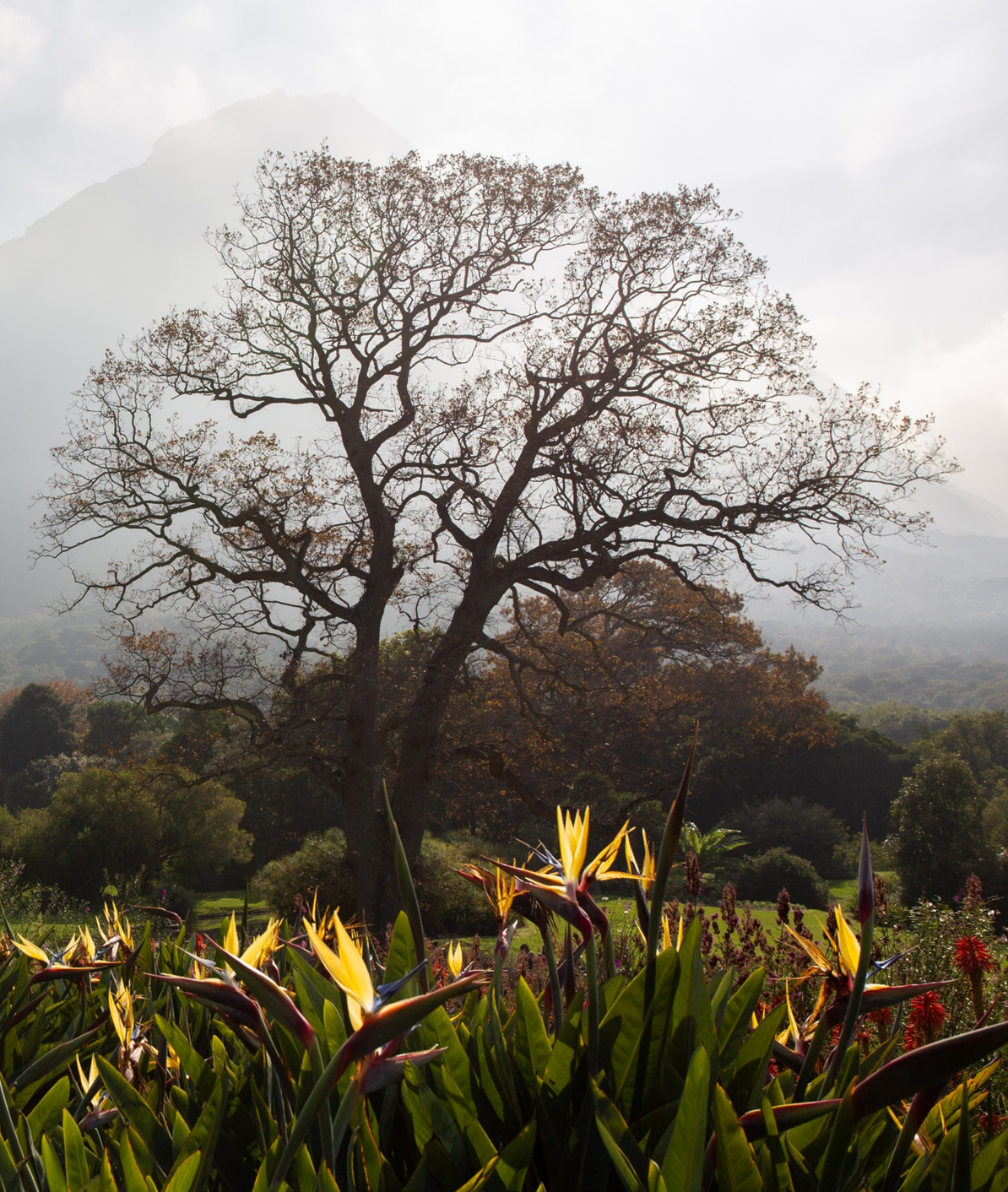
I was recently invited to deliver a keynote address at the World Urban Forest Forum held in Washington D.C, USA. Initial puzzlement at why Cape Town would be invited – a treeless biome – turned to curiosity. And a whole level of new thinking around urban forests and resilience – in a treeless biome. The blog that follows is write-up of the presentation, which I think is worth sharing.

Cape Town is South Africa’s oldest and second largest city . It’s located at the bottom of the African continent on a peninsula. It has a 2 446 square kilometer footprint and a Mediterranean climate – hot, dry summers – and wet winters. And wind all through the year. Historic data indicates 475mm rainfall per year, but this has varied radically in recent years. ‘Day zero’ ring any bells? Capetonians do. We learnt the hard way, that historical data cannot be used as the basis for forward planning any longer. But I digress. Back to trees.
Our tree canopy is between 6 and 7% and covers an urban footprint characterised by medium to low density with a population of almost 4.8 million. The economy is driven by financial services and tourism. Its location within an agricultural region makes it an important sector hub. Even though Cape Town and the Western Cape’s economies compares favourably against other South African metros, there are nevertheless also high levels of unemployment and inequality.

Natural Systems – Botanical Ecology
As you can see from the photograph, Cape Town is absolutely a mountain in the sea. This photograph captures the Table Mountain range that extends from Table Bay to Cape Point. On the right is the gently sloping Signal Hill, flanking the mountain’s north face in the middle, with Devil’s Peak to the left.
The Cape Flats is a low-lying sandy area that stretches between the foot of the sandstone Table Mountain and Hottentots Holland mountain ranges. It is visible on the left of the photograph behind Devil’s Peak. Aquifers occur across these geological formations and the groundwater they store is gradually forming part the City’s bulk water supply.
Knowing about the geology is important for understanding what will grow where.

Natural Systems – botanical ecology
The geology, soils, orientation and climate establish many different micro-climates for mountain, lowland and wetland plants. This unique botanical canvas is referred to as the Cape Floral Kingdom, or the fynbos biome. Cape Town is a conservation and biodiversity hotspot, wherein a total of 19 different and distinct vegetation types occur. This botanical uniqueness is protected by World Heritage Status, as are the Table Mountain National Park (located at the very heart of the city); Kirstenbosch Botanical Gardens and Robben Island, where our former president, Mr. Nelson Mandela was imprisoned for 27 years. The city also recently became a Ramsar wetland city.
Fynbos is spectacularly beautiful, but it is not naturally rich in trees, with low and medium shrubs and geophytes dominating. Afro-montane trees are however found in protected ravines, mountain slopes and valleys.
Lastly, low-lying areas are characterised by dune and wetland systems fed by a network of small rivers and streams from the higher mountain slopes.

Left: View of Table Mountain showing Newlands Cricket Ground and Rugby Stadium. Right: Informal settlement towards the north
Apartheid legacy
Cape Town, like other South African cities is deeply affected by the country’s apartheid legacy which is represented by under-investment in infrastructure, including open space. The city’s development started closer to the mountain in more favourable growing microclimates where older, more established areas are now located. Newer, poor areas grew down and out from here onto poorer soils and into harsher micro climates.
It follows that the geology and microclimates have also played a role in the disparity of ‘greenness’ across the city simply because it is a lot harder to grow trees on the Cape Flats, where vulnerable communities typically live.

Tree Canopy
In 2020 the Recreation and Parks Department completed the City’s and South Africa’s first tree mapping project.
The mapping used LiDAR to capture 2.75m tall trees and above in addition to:
- Area of vegetation (road reserves, parks, private land);
- Leafy versus non-leafy areas; and
- Percentage of tree canopy.
These elements establish a baseline for monitoring canopy cover changes over time. Follow-up assessments will be undertaken every 5 to 8 years to monitor changes and inform forest management priorities and plans.
This work is to prevent the kind of loss experienced between 2000 and 2020 when the city saw its canopy drop 5.9% from 12%. And direct planting to areas that need it so as to meet the FAO 10% tree canopy goal.
Resilience & Climate Change
You can’t talk about the role of urban forests for climate adaptation and resilient city-making without understanding what resilience is.
The global identification of urban forests for climate adaptation and resilient city-making, puts an onus on understanding their potential role.
Understanding what resilience is, is a start to understanding the role.
Resilience is “the capacity of individuals, communities, institutions, businesses and systems in a city to survive, adapt and thrive no matter what kind of chronic stresses and acute shocks they experience.”
Resilience recognises that climate change is one of the most significant shocks and stresses that cities are challenged with. In Cape Town we have identified their potential for heat adaptation, specifically. We must also consider that whilst urban forests have the potential for heat adaptation, which is “resilience through”, resilience “of” is also critical. This refers to the resilience of the trees and forest.
I’ll discuss the shocks a little later in more detail, but before we get there, let’s look at greenhouse gas mitigation and climate change.
Greenhouse Gas Mitigation – CSIR Study (2021)
The potential of trees to mitigate greenhouse gases is well-recognised globally.
However, in 2021, the Council for Scientific and Industrial Research (CSIR) researched the potential for trees and plants to mitigate greenhouse gases in Cape Town. It framed the research within the context of changing earth systems and the need to remove carbon dioxide to offset the accelerating pace of global emissions.
The research concluded that the sequestration potential for all vegetation was about ~1% of Cape Town’s emissions, but that this could be increased by improving green spaces, planting trees and restoring habitats, which would potentially get us up to 2%. The reality is that South Africa’s, and Cape Town’s energy is generated by coal fired power stations. This is changing fast, and Cape Town is leading the way, but mitigating greenhouse gases will remain a challenge for some years to come.
Importantly, what does this mean for Cape Town which occurs in a treeless biome? If trees can’t do it? What can? And is it really fair to make it their sole responsibility?
Climate Change Action Plan (2021)

In 2019, a climate change hazard, vulnerability, and risk assessment study was conducted for the City of Cape Town.
Key climate risks based on both the likelihood of a hazard occurring, the magnitude of the hazard, and the likely impact of the hazard on vulnerable people and infrastructure were identified.
Increased heat, heat waves, and very hot days were flagged as significant risks for Cape Town, particularly within urban are affected by heat islands. The number of very hot days, days that are 35 degrees and more will increase to up to 20 days; heatwave days; days that are 32 degrees for more than 3 consecutive days will increase up to 10 days; as will the high fire danger days that will increase up to 20 days. Far future predictions (right column) are even worse.
The heat map on the right illustrates the impacts of the urban heat island effect across the city. Areas most affected are along denser transport corridors where heat is intensified by building materials and building density, in addition to the lack of green. Other vulnerable areas are located on the Cape Flats where heat is particularly acute for those living in poorly built or informal structures. The interior temperatures in these structures can exceed 40 degrees on hot days.
Recommendations are for tree-planting and an urban greening programme. The City is in the process of preparing a Heat Action Plan that includes other interventions such as cooling centres.
Other risks that will affect the greening recommendations are:
- Drought and associated water shortages
- Flooding and associated impact on people and infrastructure
- Coastal erosion and sea-level rise, and associated impacts on coastal infrastructure
To date, climate responsiveness appears to focus on heat and how it affects human health and vulnerable people. I’d like to suggest that additional consideration is needed for other parts of our urban eco-systems, such as trees – and biodiversity loss.
Resilience Strategy (2019) – Open Space Working Group

Cape Town’s resilience strategy is an important part of the policy puzzle because it in many ways sets the stage for the Climate Change strategy. It was developed with support from the Rockerfeller 100 Resilient Cities network and was approved by Council in 2019. The strategy identified pillars, goals and actions, including the establishment of an Open Space Working Group that speaks to a connected, climate adaptive city and envisions Capetonians working together to create place-based responses to shocks and stresses, with a goal to build climate resilience.
The Open Space Working group is the only opportunity for officials to engage around open space, across disciplines and line departments in a way that is generative. Online sessions frame themes which we then explore on site where we can see how policy and management come together, and from there identify what is working well, but also opportunities for improvements.
The webinar sessions looking at Green Infrastructure highlighted issues with managing forests in urban areas, whilst the City and open space sessions highlighted challenges in developing green public spaces, including trees. The image above is of the Klaasenbosch Greenbelt visit where canopy thinning is allowing understory fynbos to establish. The greenbelt connects Table mountain along a waterway and wetlands to the Cape Flats and ultimately the sea.
Successes of the Open Space Working group are numerous, but largely because it is the only opportunity for officials to engage around open space together, across disciplines and line departments in a way that is generative. I feel that many local government officials are reluctant (or too busy) to leave the office and get onto site, which is a danger because our work almost always intersects and the success or shortfalls of policies and strategies are most often only visible through implementation – on site. Hosting online webinars has also worked well because we have been able to share international best practice, which has been incredibly inspirational.
The Open Space Working Group is an action that the Risk and Resilience Department drives, but actions towards climate adaptation and mitigation lie with many other departments, including our colleagues within the department in the Climate Change team.
Cultural Landscapes

Trees are a long term investment. And those who plant them, are not always the ones to benefit. Non-indigenous trees were brought to the Cape by Dutch settlers who quickly identified the potential for wine farming. They planted English and Cork Oaks with the intention of using the wood for wine barrels and corks. The relatively high winter temperatures inhibited the hardening of the wood, making it unfit for purpose. The remnants of these estate plantings structure many of the city’s grand avenues and give the Cape Winelands its unique cultural landscape.
Cape Town’s agricultural character extends even further with the planting of long eucalyptus trees avenues northwards from the city to provide shade for agricultural produce moving between farms and markets.
Other important trees are sometimes single trees that were distinct and served as a central meeting place for trade, such as the Money Tree in Kalk Bay.
The point of this is to illustrate that trees are also important makers of urban place and markers of history.

Early settlers used up Cape Town’s Afro Montane forests for building materials. The fragments that remain, are similar to what is found in Skeleton Gorge in the Kirstenbosch Botanical Garden.
Commercial plantations, such as the Tokai forest, have replaced indigenous forests in some areas. Logging in recent years and the absence of renewed planting, has thrillingly allowed the in-situ seeds and bulbs to re-emerge.
Controversy however surrounds the forest’s management, that includes further tree felling. Those pushing for fynbos rehabilitation, are delighted. Those keen for shade and amenity, are less so. These latter took the issue to the High Court where the judgement protected the trees.
Both of these forests, and others – are very popular recreational areas.
Arboreta – Arderne Gardens

The Arderne Gardens is another popular recreational area. Planted by Charles Arderne in 1845, it benefitted from Cape Town’s location along shipping routes to the east and beyond and is now home to the finest collection of exotic trees in Cape Town.
It includes two particularly impressive creatures. Firstly, the Moreton Bay Fig, or Wedding Tree as it is commonly called, shown in the photo in the middle, which is believed to be the largest tree in South Africa; and the Aleppo Pine (on the left) which is possibly the world’s biggest of its kind.
Cultural symbols – Constitutional Court – ‘Justice under a tree’

As previously mentioned, individual trees have played a role in structuring places of trade. They have also provided sheltered place for teaching – and indabas, which are meetings to discuss serious topics.
This tradition and cultural practice, generated the concept for the Constitutional Court– of justice under a tree. Justice Albie Sachs articulates this beautifully – “”The inside-outside visibility of the Court communicates something that is somewhere between subliminal and liminal. Perhaps “interliminal”, a consciousness of justice under a tree”.
South Africa’s constitution enshrined the hopes and dreams of a nation after a very dark time in South Africa’s history.
The symbolism of a tree could not be more appropriate. It represents a living ‘being’ that changes over time and miraculously, works collaboratively within nature’s web. They are imbued with reverence and respect as the elements that structure places of justice.
Looking forward to the present, what inspiration can trees give us when facing the challenging world of the Anthropocene?
In this section titled – “Trees in the Anthropocene” I’ll discuss the various ways that Capetonians and climate change are affecting trees in our city. I will also highlight the importance of considering other aspects of climate change, over and above heat, connecting back to the ideas of resilience “through” and resilience “of”, whilst unpacking other shocks and urban challenges.
Urban Infrastructure

Urbanisation affects natural systems in many different ways. Utility planning, for example, often does not include sufficient width, nor clear depth for trees. Conflicts with infrastructure elements such as lighting, trunking, stormwater and water – potentially prevent street planting.
Infrastructure is furthermore treated as monofunctional, which makes it easier to measure and report on – but limits its potential to provide other services. This limitation results in, for example, water being treated as an enemy, rather than as an important part of the urban environment that if correctly designed, could be used for passive irrigation and groundwater recharge. These issues are largely because ‘greening’ is viewed as beautification, rather than as critical infrastructure that builds liveability and promotes urban health. For this reason, it receives minimal budgets.
It follows that there are many stumbling blocks to progressing a green agenda in the built environment and they often reside in other, bigger wicked problems.
Informality, urbanisation & densification

These wicked problems reside in meeting the challenges of poverty, rapid urbanisation and increased informality often in climate vulnerable areas. The lack of planning, density and oftentimes the location of the dwellings in flood plains and wetlands, make it difficult to plan, budget and retrofit elements in.
Redevelopment and subdivisions of older parts of the city is supported by the City because it will improve the densities needed for public transport efficiencies. But – it also often also triggers the removal of mature trees. The developments that follow, of either apartments or smaller plots, are simply too small for trees.
Planned new developments are equally problematic and have similar issues to those just discussed. But there are also other issues. Developers just don’t want to spend money on landscaping and maintenance.
Lastly, criminals hide behind trees and large shrubs leading to their removal by those living in communities, either because of actual incidents, or as a preventative measure. This issue has undermined many City-led projects over time and is a very real threat to future open space projects and street tree planting.
Bark Harvesting

Whilst tree removal is an issue, bark removal is equally problematic.
Bark Harvesting for medicinal and cultural purposes has become a serious threat to Cape Town’s trees.
Expert advice recommended painting PVA onto tree bark, rendering the bark unattractive for harvesting. Fortunately, the mixture does not pose any risk to the tree, nor is it toxic to humans. This measure is necessary, but it also limits cultural access to trees.
Urban forest threat to biodiversity & climate adaptation

The removal of ‘alien’ trees for fynbos rehabilitation also threatens the city’s tree canopy.
And the planting of trees threatens biodiversity. The reality is that urban areas are highly modified. Strategically planted trees in urban areas is unlikely to significantly threaten biodiversity, and the benefit presumably outweigh the risk which can be mitigated by clever planning, design and management.
Water Management

But there are ‘aliens’ and ‘aliens’.
Those located in our water catchments are the most evil of all. Active removal has been a successful part of the City’s Water Strategy with estimates suggesting that 55 billion litres per year has been saved – at a 1/10thof the cost of alternatives such as desalination. And this doesn’t include the benefits to biodiversity, or anything else.
But closer to home, within the city, trees have played a role in managing the water table, which breaches in the winter. For thousands of Capetonians, this annual flooding is devastating. For trees too. It is a hostile environment that few trees can survive. And those that can, are often non-indigenous.
On the one hand trees could play a bigger role in managing flooding, but on the other – they would become competitors for water during future droughts, highlight the enormous complexity held within urban environments.
Polyphagous Shot Hole Borer (PSHB)

This example is kind of like nature against nature, but nevertheless stems from globalisation.
The polyphagus shot hole borer is a beetle that originated in Indonesia. The beetle tunnels into tree trunks to lay eggs and as it digs, it releases the Fusarium fungus that covers its body. The fungus invades the tree and eventually blocks the tree’s vascular tissue. Depending on tree species and level of infestation, this kills the tree.
Maples, oaks, some willows, plane trees, avocado trees, some fruit trees, acacias and some indigenous trees are susceptible. This list includes some of the most common and valuable trees in Cape Town, posing a very serious risk to ecosystems and urban forests.
There is currently no registered or fully effective treatment for either the insect or the fungus. But – there are promising trials under way.
The polyphagus shot hole borer represents an existential threat to Cape Town’s trees. But it is also an opportunity to lobby for funding to implement a wide-scale planting programme that will see the continued implementation of plans such as the Greening of the City plan developed in the 1970s, that for some reason fell dormant. This new ‘push’ has the potential to realise climate adaptation and resilience at scale.
Fire

It may sound contrary to common sense, but in the Western Cape, we need fire. Fynbos needs fire to regenerate.
The trouble is that we have too much fire and the increased frequency reduces regeneration time and compromises its health. Alien invasive species, higher temperatures and drought all dramatically increase the risk of fire.
This poses a significant challenge for managing open spaces, biodiversity and nature reserves that are located in close proximity to urban settlements.
The fire in 2021 at the Rhodes Memorial and the University of Cape Town is emblematic of this challenge. The fire was human started and burnt significant parts of the university’s library and the Memorial. Even though the university and City maintain their firebreaks, others did not.
Whilst the buildings and contents were insured, the landscape was not. They never are. This limits the potential for rehabilitation and increases the risk of permanent eco-system damage.
The fire was frightening and destructive. But – it has also offered an opportunity for rebirth. For example, the University of Cape Town now has the opportunity to draw the mountain down into the campus, in contrast to the historic scheme that kept the mountain at bay. There is deep symbolism here connected to our colonial past, represented by the imported trees and artificial, protected boundaries.
Even though fire is ‘good’ for fynbos, it is less so for trees. It shouldn’t be a surprise that between 2001 and 2022, fire was the largest cause of tree canopy loss.
Wind

Fires and wind often go together in Cape Town. High winds fan fires and affect the growth and size of trees across the city. For this reason, comparatively few trees in Cape Town are champion trees because they fall short of the size criteria.
Cape Town’s trees also have shallow root systems which affects their ability to anchor in sandy soils. Heavy rains also saturate and loosen soil around tree roots, adding vulnerability to high winds, as illustrated in the photo at the bottom.
Where to from here?
Resilience can be a bit gloomy and pessimistic. But it needs to be to ensure we anticipate the worst and deliver the best.
So even though trees may provide climate adaptation, their vulnerability to other climate shocks and stresses, may make them less able to. This section discusses some of the work that the City is busy with towards increasing its tree canopy including:
1.The Urban Forest Policy
2.Green infrastructure Programme
3.Conservation and Preservation; and the
4.Ten Million Trees Programme
Urban Forest Policy

The Urban Forest Policy is an important connection to the Climate Change Strategy and implementation.
It essentially promotes the protection of existing trees and the planting of indigenous and drought resistant, non-invasive trees that are also resistant to the Polyphagous Shot Hole Borer.
Whilst it promotes planting in areas vulnerable to heat stress, the process of identifying these areas and developing an implementation programme has not commenced.
Lastly, it promotes efficient watering and use of alternative water sources. As we discovered during the drought, there are many different potential ‘alternative’ water sources. And not all are suitable for irrigation. For example, fynbos does not respond well to nutrient-rich greywater and its extensive use can also be destructive for soil structure and is therefore unsuitable for other plants too.
We all want to see our cities verdant and thriving, but during droughts, competition for water will force difficult decisions. Protecting their survival may mean having difficult conversations with road engineers and stormwater managers. We need their help to redirect stormwater into planted areas. But this needs a culture shift from stormwater as an enemy to stormwater as a resource.
Green Infrastructure Programme

Green Infrastructure Programme protects and enhances existing natural environmental assets, as well as promotes and creates new green infrastructure assets.
Supports sustainability, enhances the city’s living environment and improves resilience to the effects of climate change.
Tree Guideline – Best Practice Promotes tree care and planting
Conservation & Protection

The Development and Conservation of Greenbelts, Natural Assets in New and Existing Residential Settlements
Cape Town’s rapid expansion, often into unplanned informal settlements or in some cases poorly planned urban sprawl has led to the fragmentation of natural vegetation, which in turn has exposed the City’s flora and fauna to great impacts of invasive alien species invasion and possible extinction of indigenous flora.
In an effort to contribute to the national conservation targets, the City as whole has taken strides in its conservation efforts. Over 32 nature reserves have been proclaimed over the years by the City’s Environmental Management Department. The Recreation and Parks department has also proclaimed 16 Biodiversity Agreement sites under the CapeNature ordinance and has various Public Open Spaces, Parks and road verges that are protected during August until November months to allow fynbos vegetation to persist.
Fragmentation of biodiversity is addressed through the development and conservation of greenbelts within the city. These are aligned to Local Biodiversity Strategies and Plans and Bioregional Plans, to connect conservation areas and public open spaces into a wide web.
Two Million Trees Programme

The Two Million Trees Programme aims to meet the challenge implicit in the city’s canopy shortfall and respond to the directives of the new Urban Forest Policy.
The aim is to maximise sustainable planting of trees within transformed and modified urban areas in order to increase percentage canopy cover and address disparity between leafy and non-leafy areas.
The programme seeks to balance biodiversity and need for shade trees by promoting new tree planting using suitable species in Public Open Spaces, Road Reserves, Parks, Sport fields and new developments.
Increasing the tree planting numbers citywide will necessitate promoting tree-planting amongst members of the public, private companies, community organisations and other City departments. These include partners such as ICLEI and TreeKeeprs who work with the public and the City to protect and enhance the tree canopy. Other important partners are the ‘friends’ groups established around parks to help with their management and activation. The Friends of Arderne Gardens is a good example of this.
Conclusion

So in conclusion – I hope this presentation has provoked deeper thinking about the world we are living in. It is a deeply uncertain place, challenged by shocks and stresses. We need to embrace the fact that the world we are living in is not benevolent. To humans. Or nature. For this reason, we must be mindful, thoughtful and careful with our limited resources.
The following thoughts are really to guide how we “think forward”.
As illustrated earlier in this presentation, for a treeless biome – Cape Town has quite a few trees. And they are much loved.
1. Nuanced approach that recognises the complexity of urban environments, social systems, hybrid infrastructures and climate impacts within a biodiversity hotspot, in addition to the unique micro-climates throughout Cape Town.
2. Strong long-term vision that considers trade-offs via a business case that responds to the challenges of rapid urbanisation and informality; and importantly, that can challenge decision-making determined by economic arguments around job creation that undermines future resilience objectives.
Achieving this will require a very different approach that considers (3) the resilience ‘of’ and resilience ‘through’, grounded in the understanding that (4) trees, urban forests and landscape elements in general are critical infrastructure, rather than superficial add-ons for beautification.
But nature cannot do it alone. The spectre of the Anthropocene is such, that built environment and city-making must also radically change and form part of a ‘basket of options’ – many different hybrids – that together provide robustness, flexibility, adaptability, redundancy – all the qualities of resilience. It very much relies on “and”.
And finally, even though the polyphagus shot hole borer crisis and other challenges pose existential threats to our existing canopy, we have a rare opportunity to reimagine the role of trees – in Cape Town – a treeless biome, in a way that protects our biodiversity, transcends our colonial past – and builds climate resilience.
Because there is little doubt that urban forests play an important role in ensuring that Cape Town is able to “survive, adapt and thrive no matter what kind of chronic stresses and acute shocks it experiences.”
Subscibe to the low volume newsletter and get updated when there are new articles