Bad things happen. Be prepared. A checklist for navigating a cancer diagnosis and treatment.
A dread disease diagnosis, like cancer, is life-changing. Navigating the diagnosis, treatment and recovery can be aided or encumbered by financial and professional considerations. I was diagnosed with bilateral breast cancer in March 2024. I took six months off work when treatment started at the end of May and have been back at work for a week. I’ve prepared a checklist of my most important takeaways mostly for the work environment, which may be useful.
- Take your health seriously and keep your checkups regular. Health is often seen as a nice-to-have, something to work on if there’s time. I realised that time was not as elastic as I thought when I popped my calf muscle at the end of 2022. I got a fright at how unfit I’d become. In the new year I joined the gym. It was hard. But by the beginning of 2024, I was stronger and fitter. All the screens (City of Cape Town ‘Know your numbers’ and my gym checks) were positive. I was finally out of the amber, danger zone and into the average. I had never been more pleased to be average. Through hard work and discipline, I’d brought all my risks of disease right down. Whilst these screenings didn’t detect the cancer, they are still is important the first step to detection, treatment and cure. Some of the procedures are uncomfortable. But less so than a disease detected too late. I have an annual gynaecological check-up. My doctor is very thorough, and she includes a full health check. In the past she detected a lump, but it turned out to be a cyst. So when she detected a lump in March last year, I wasn’t worried. My family has no history of breast cancer – none. For this reason, mammograms are a grudge test that I have done in the past, because I am told to. Imagine my surprise to discover through the mammogram, that I had a lump. Imagine then, my extreme shock when the MRI detected ANOTHER lump in the other breast. I had not one, but TWO breast cancers. Bilateral breast cancer. At times I’ve railed at the universe for the ‘wasted fitness’. But it wasn’t long before I reaped the benefits. Your health is important because a healthy body can better prevent cancer and it also improves your body’s resilience to cancer treatment. I’m mostly back to square one – deep in the ‘red’, despite every effort to keep up with exercise, but it’s OK because my experience of this journey, would have been worse without my improved health.
- Medical aid is not a catch-all. Medical aid schemes are complex and difficult to navigate. They’re even more so when you’re in crisis mode. Considerations worth noting are networks and financial implications associated with treatment from specialists not in your network. Just like any professional network, your doctor may have doctors they like to work with, but they may not be in your network. They may also charge up to 500% and nowhere near the medical aid rate. It’s a rude awakening when you realise that your 100% coverage is not actually 100%. Get gap cover, if you don’t already have it. It can feel like a grudge purchase, but the amount is small in the bigger scheme of things considering the peace of mind it buys you.
- Navigating medical professions. A cancer diagnosis takes a whole team, the size of which varies. In my case the team included: gynaecologist, gastroenterologist, anaesthetist, radiologist (many), pathologist (many), oncologist, nuclear medicine specialist, geneticist, surgeon, physio, chemist, nuclear physicist, cardiologist, yoga guru and beauty therapist. The team may be well co-ordinated. Or not. Navigating the complexity of procedures, inputs, considerations, interactions etc. is virtually impossible for a non-medical person and in some instances, doctor’s opinions were not aligned. Understanding whose opinion to follow can be tricky. But – know that if you have cancer – your oncologist is your go-to. At one stage I had been led to believe that I would need a double mastectomy. It was a very, very difficult process, so you can imagine my surprise when I discovered that it would not be necessary. Rarity is not desirable in medicine. You really want to be bog standard and supported by tons of data. Because rarity makes knowing and evaluating risk – and making informed decisions – tricky.
- Understand what things cost. Some doctors may provide a quotation. It may however arrive without time to actually make an informed decision. You may also be in crisis mode and feel pressured to make a decision as quickly as possible. Most of us are unlikely to have a list of alternative specialists to select from and starting a whole new process is daunting when you’re in crisis and desperate to start treatment. Know that a quotation for a procedure won’t include all the specialists involved. A surgeon’s quote won’t automatically include the anaesthetist, hospital and pathologist, you may need to ask for this detail – if you prefer to have some control over how your medical aid is being spent. At times it can feel like having medical aid provides medical practitioners with a blank cheque and that if you have it, there’s no need to be explicit regarding costs. I’ve even been advised not to disclose that I have Gap Cover because it can be used as an invitation for charging exorbitantly. Yes, I know this is your health and no price can be too much, but there are thresholds. Submissions direct to the medical works up to a point, or rather – until your benefit threshold is reached, but it can be a hassle to reconcile claims and treatment at a later date, so ensure that you get invoices – and understand them. Also, make sure that you have all the information regarding approvals. Proceeding without approval for a procedure (e.g. MRI) or a treatment plan (chemo) will cost extra as will treatment that isn’t assigned the correct code.
- Bad stuff happens. Even if you’re an optimist. We can’t plan for everything and having insurance can significantly alleviate unnecessary stress. Dread disease insurance provides a buffer in the event that treatment exceeds medical aid benefits, it also buys you extra leave when sick leave is exhausted.
- You are not a hero. All the websites tell cancer patients to avoid stress. Any cancer patient who has single-handedly navigated medical professionals and medical aid, will know how difficult this is to do. Add professional responsibilities to the list, and it is nigh impossible. As a government employee, we are allocated sick leave. At the beginning of the 3-year cycle, it can seem generous, assuming you typically have sniffles and maybe a bout or tow of gastro. But it’s wholly insufficient when you have a breast cancer diagnosis which requires 6 months for treatment and (part) recovery. Some cancer patients may elect to work through treatment. Others, like me, opt for a clear break. The rationale for my decision was to selfishly protect my health and process. I found that my health during treatment was undoubtedly improved thanks to being able to focus entirely on it. My sick leave did not cover the leave necessary for treatment, even after an additional allocation was approved. I was able to take the full amount thanks to insurance. Again a grudge purchase, but it has been worth it.
- Walk proud. Sharing bad news, particularly cancer, is difficult to do sensitively. Your news is important to you, but it may also be a trigger for others. For this reason, accept that you’ll most likely receive a mixed bag of responses. On occasion, knowing that people were trying to be helpful, was something I did have to remind myself of, even though their comments felt insensitive and judgemental. Shielding oneself but also owning your chosen understanding of your disease and treatment, is something that should make you feel proud and is worthy of respect from others.
- You are not alone. I work with many different people across departments. Setting up an email auto-reply saying I would be off work for six months was, I felt at the time, more likely to cause confusion and frustration. And unwanted For this reason, I was open with everyone I worked with about my diagnosis which helped to manage expectations. Through this process I was shocked to learn how many colleagues had walked their own cancer journey, or whose family member or close friend had. Being open about my diagnosis opened me to a network of support I would not have otherwise had. And made me feel less alone. I also hope that it gave everyone a big wakeup call that health should not be taken for granted and to succumb to the temporary discomfit of screening procedures.
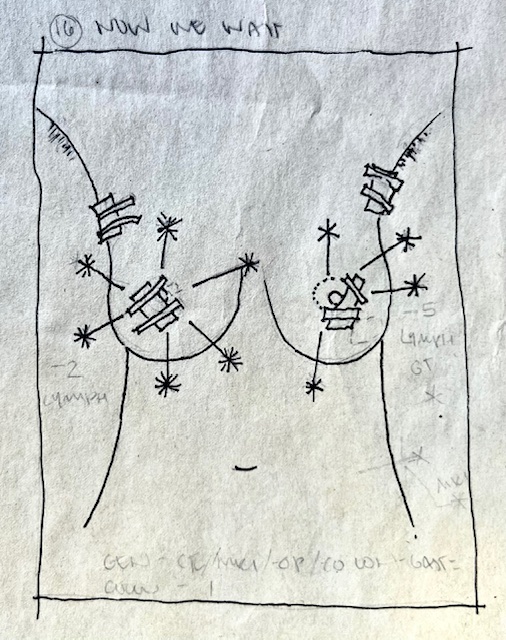
- Mark the journey. A cancer treatment journey can feel interminable. I found that creating calendars, just the month with daily blocks, helped to plan it out. Defining milestones in the calendars helped to break the journey up and provided a tangible artefact that I could tick off. Drawing each experience also helped. As did lighting a candle at the end of each month of chemo. It was deeply emotional lighting the last candle and over the subsequent months, experiencing the gentle glow as the days and nights passed has been a gentle reminder that the worst is over. These small activities and gestures went a long way to building a sense of momentum and achievement. I only regret not continuing the ‘mapping’ after treatment. The recovery journey has been exhilarating. I wish I’d recorded the moment I realised I’d lost my eyelashes (which happened after chemo ended) – there was nothing to apply mascara to. Utterly hilarious because until that moment, I had had no idea that they were gone. Or my first haircut…I wasn’t allowed to use soap or deodorant during radiation – only Maziena. Returning the container to the pantry was big. The moment that really stood out for me – empowering and emotional all at once – was a moment at the spa, when semi-naked, I realised I didn’t have to expose my chest to a complete stranger. Finally, ‘they’ were mine and I could choose how much, or how little to share. Small moments, but significant.
- You will never be the same. I have never taken six months off work. Or certainly not since I was a teenager. My working persona is a core part of who I am. Stepping away from this persona and accepting a much smaller world, was not as challenging as I had thought it would be. Becoming comfortable with doing – well, not a lot – and accepting very little in terms of tangible outcomes was tricky initially, but then it was also amazing how quickly this uncomfortable phase passed. Perfecting cardamom buns, making a quilt and keeping up with medical commitments can be ‘enough’. Who would have thought?
These reflections are intended to help, if possible. Everyone’s experience is likely to be unique, because we are all different. But – there are also commonalities.
Subscibe to the low volume newsletter and get updated when there are new articles
Thank you so much for sharing so practically and vulnerably Tamsin. I have friends going through cancer treatment and it’s helpful reading firsthand perspectives like this and learning. Wishing you all the best as you continue to heal.